You've spent an hour wrestling with an angle grinder, throwing sparks everywhere, only to end up with a uneven edge. In reality, there is a faster, cleaner way to cut metal-one that feels as effortless as drawing with a pen, rather than a battle against a bulky machine. Finding the best plasma cutter for your home shop completely transforms how you tackle repairs and creative weekend projects.
Think of this tool as a highly focused bolt of lightning held right in your hand. When comparing a CNC plasma cutter vs oxy-fuel torch, it quickly becomes apparent that plasma cutting technology-which uses compressed air to generate an ultra-high-temperature arc-eliminates the need for complex gas handling and a lengthy learning curve. According to standard manufacturing process data, this plasma arc technology cuts steel far faster than traditional mechanical cutting methods.
With advancements in modern technology, equipment that was once strictly industrial-grade has become highly suitable for DIY enthusiasts. Thanks to inverter cutting technology, the bulky internal transformers of the past have been replaced by smart, lightweight electronic components; many compact models can even be plugged directly into standard 110-volt household outlets without tripping the circuit.
By steering clear of obscure technical jargon, you can find a plasma cutter that fits both your budget and your garage's actual electrical setup-whether you are repairing a rusty exhaust pipe or creating garden art.
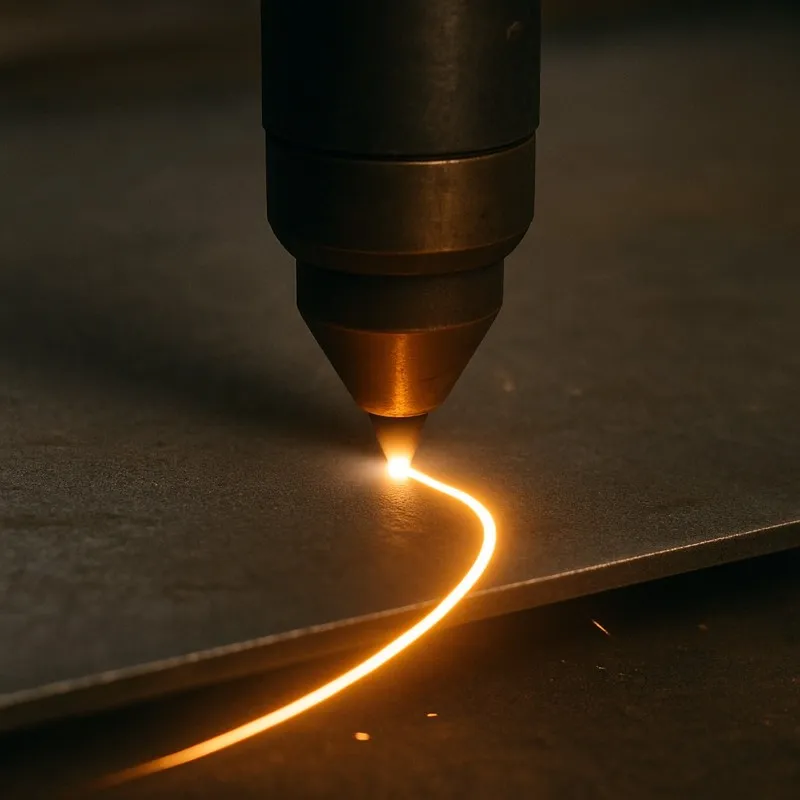
Voltage and Amps Decoded: Will Your New Cutter Trip the Garage Breaker?
Before bringing the cutter home, you must verify whether it will trip the garage circuit breaker. It is crucial to distinguish between "input current" (the power drawn from the wall outlet) and "output current" (the thermal energy used for cutting at the torch).
You can think of the output current like a volume knob: turning it up allows you to cut thicker steel, but this comes at the cost of drawing more input current from your home's electrical circuit. Ultimately, for DIY enthusiasts, the ideal plasma cutter is one that offers adjustable current, allowing it to match your existing electrical setup.
Marketing specs often exaggerate, so here is what your home circuits can actually handle for a smooth, clean cut:
- 15-Amp Circuit (Standard 110v): Perfect for auto body sheet metal up to 1/8-inch thick.
- 20-Amp Circuit (Upgraded 110v): Comfortably handles lawnmower brackets and exhaust pipe up to 1/4-inch.
- 50-Amp Circuit (Dedicated 220v): The real-world metal thickness capacity for 50-amp machines hits its sweet spot at 1/2-inch steel.
Choosing equipment with a dual-voltage (110V/220V) power supply meets current needs for use with standard wall outlets while allowing flexibility for future garage wiring upgrades.
The Pilot Arc Advantage: Why You Should Never Buy a 'Touch-Start' Machine
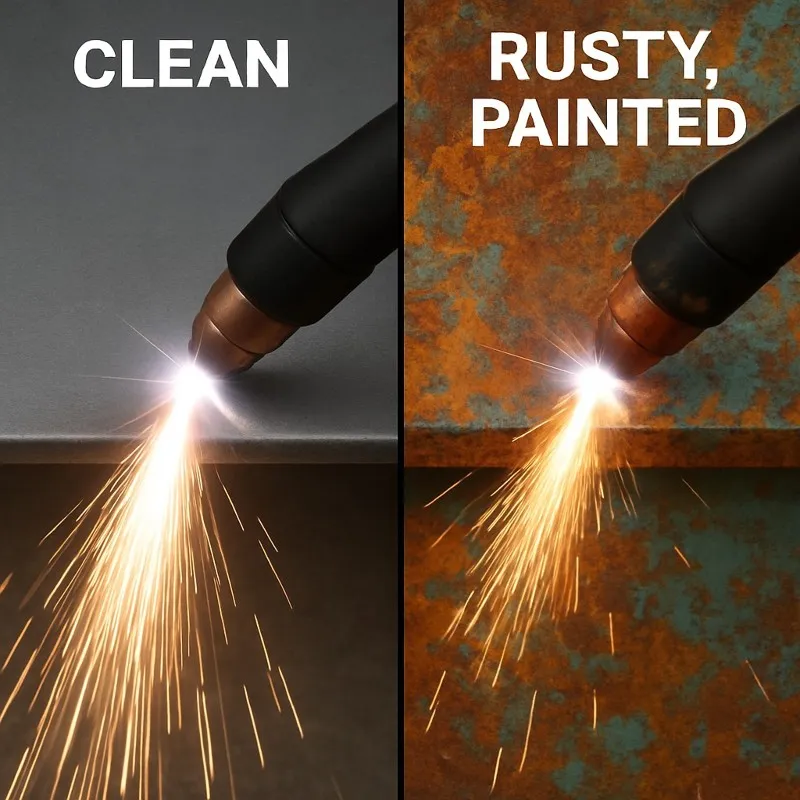
It is incredibly frustrating to have to spend hours scraping away rust and paint just to make a simple cut. With "pilot arc" technology, however, such tedious preparation is unnecessary. Functioning like a continuous bolt of lightning, this feature projects a plasma arc without requiring contact with the metal, allowing you to cut straight through rusty exhaust pipes or painted fences without the torch cutting out.
Arc ignition methods are primarily categorized into two types: "high-frequency ignition" and "blowback ignition." High-frequency ignition utilizes high-voltage electric sparks, whereas blowback ignition relies on an internal pneumatic piston; the latter does not interfere with nearby computers or sensitive electronic equipment in the garage. Both methods allow the torch to hover at the desired position, thereby avoiding high-temperature slag spatter and preventing immediate damage to the copper torch consumables.
To truly understand a machine's performance, one must distinguish between "smooth cutting" (high-quality cutting) and "severance cutting" (rough cutting) capabilities. A machine rated for a one-inch severance thickness can often only barely cut through the metal, leaving behind jagged edges that require extensive grinding and finishing; in contrast, its smooth cutting capacity is typically only around half an inch.
Avoid the 'Sprinting' Trap: Understanding Duty Cycles and Air Requirements
If you apply excessive force during operation, the tool may shut down due to overheating; therefore, the concept of "duty cycle" is crucial for beginners. Think of the machine as a runner: a 60% duty cycle means it can "sprint" for 6 minutes but must then "catch its breath" for 4 minutes. While cutting through a single rusty exhaust bracket typically won't push the tool to this limit, you need to pace yourself when making long cuts through steel.
Airflow is another critical factor. Whether you choose a built-in compressor or an external air source, the air supply system must meet the tool's CFM (cubic feet per minute) requirements. Most DIY cutters need an airflow of approximately 4 CFM at 60 PSI to effectively blow away molten metal. If the compressor in your garage lacks sufficient performance, air pressure will drop, causing the plasma arc to become unstable and resulting in a jagged, uneven cut.
Even with optimal air pressure, residual moisture within the air lines can rapidly damage copper cutting nozzles. Moisture causes the high-temperature plasma arc to spatter and become unstable; therefore, ensuring a completely dry airflow is the ultimate key to extending the service life of plasma torch consumables.
Follow this quick filtration checklist:
- Drain accumulated water from the main compressor's air receiver tank daily.
- Install a standard moisture-separating filter directly on the equipment.
- Add an in-line desiccant filter cartridge with a color-change indicator to remove trace amounts of residual moisture.
Keeping the hardware dry and cool not only maximizes cutting efficiency but also creates favorable conditions for high-precision processing and the reduction of dross and waste.
Slicing with Precision: 3 Pro Tips to Minimize Dross and Save Money
While pulling the trigger to cut is certainly exciting, moving at the wrong speed results in jagged edges and the accumulation of solidified metal droplets known as "dross." Moving too fast causes sparks to spray directly at the operator, while moving too slowly leads to a rough cut caused by the beam melting away too much material. The ideal cutting technique is akin to tracing lines with a marker: using a steady dragging motion directly across the workpiece surface keeps your hand stable, ensuring a clean, neat cut.
The gap formed after a laser or plasma beam vaporizes material is known as the "kerf width," and maintaining a narrow kerf is key to high-precision cutting. When troubleshooting issues such as poor cut quality or excessive dross, novices often mistakenly assume they should increase the current; in reality, raising the gas pressure is more effective. A more powerful gas flow concentrates the arc and blows away molten steel before it can permanently adhere to the metal surface.
Understanding these operational characteristics helps in selecting a plasma cutter suitable for home use. Choosing a machine equipped with an easy-to-use, built-in pressure regulator allows you to adjust parameters more conveniently and achieve perfect cutting results.
Your Metalworking Upgrade: Final Selection and Safety Essentials
To choose the ideal plasma cutter for home use, simply follow three easy steps: check your garage's electrical load limits, set a reasonable budget, and select the right type of unit based on the thickness of the materials you typically work with.
Before you start cutting, you must equip yourself with the necessary safety gear to protect against UV rays and hot sparks.
Have the following essentials ready:
- Safety glasses with a Shade 5 rating (standard welding helmets are usually too dark).
- Heavy-duty leather gloves.
- A flame-resistant apron.
Once you have clarified your working conditions and gathered your safety gear, you can finally say goodbye to that bulky, messy angle grinder and switch to a tool that slices through steel as easily as cutting butter.
Read More: Choosing the Right Plasma Cutter for Steel
Read More: Choosing The Best CNC Plasma Table Kit
Please fill the form Below ''Send Inquiry'' for more suggestions.
Or click Top Menu "Contact Us" for more professional advice.