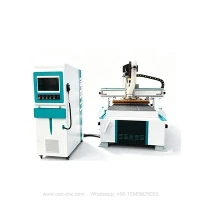
The ATC CNC Router with Saw Cutting is a fully upgraded version of the conventional straight‑row tool changing CNC router and an advanced device for intelligent panel furniture manufacturing. Based on the original structure and functions of ordinary straight‑row CNC routers, this machine is equipped with a high‑precision main and scoring saw assembly. It is specially designed to greatly improve the linear cutting speed of wood panels and optimize cutting edge quality. Meanwhile, it realizes the stable cutting of thick boards and multi‑layer boards, which cannot be achieved by ordinary CNC nesting machines. Retaining all core advantages of standard straight‑row ATC routers including automatic tool changing, multi‑functional milling, drilling and grooving, it solves the industry pain points of slow milling cutting speed, easy chipping and limited thick board processing. Adopting the dual processing mode ofmilling for shaping and sawing for straight cutting, it has become the core equipment for large‑scale customized furniture factories to improve production capacity and processing quality.
The ordinary straight‑row ATC CNC router is the basic mainstream equipment for panel furniture processing. Equipped with a straight‑row tool magazine and high‑speed milling spindle, it can automatically switch different milling tools to complete full processing procedures, including panel nesting, vertical drilling, horizontal grooving, door profile milling, hollow carving and other customized shaping works. It is widely applied in customized furniture, solid wood parts and decorative panel processing fields. Thanks to its flexible shaping performance, it is highly favored by small and medium‑sized factories with multi‑style and small‑batch orders. However, all cutting and nesting processes rely entirely on milling tools. It has inherent shortcomings such as low linear cutting efficiency, easy edge chipping on veneered panels and poor adaptability to thick boards, making it unable to meet mass production demands of standardized panels.
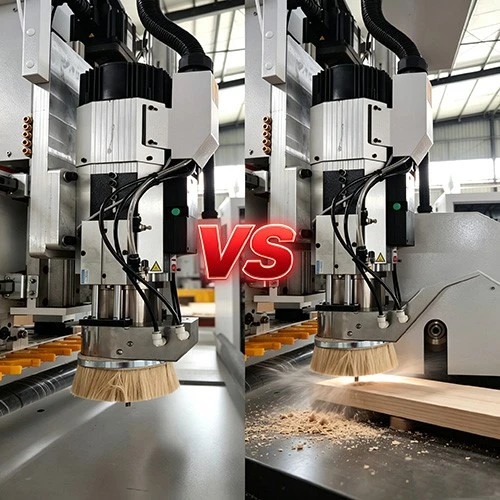
As an upgraded model, the CNC Router with Main & Scoring Saw adopts an independent dual processing system of ATC spindle + rotatable main and scoring saw, with two sets of working units operating independently and cooperatively without mutual interference. The saw group consists of a small scoring saw and a large main saw. During operation, the scoring saw pre‑cuts the panel surface to split the veneer and stabilize the wood fiber structure, while the main saw completely cuts off the board. This fundamentally eliminates edge chipping and burrs on veneered panels. In addition, the saw group supports 90° automatic rotation, flexibly adapting to horizontal cutting, vertical cutting, large board sizing and doorjamb squaring. It balances high precision and high efficiency perfectly, fully meeting the demands of large‑scale panel blanking production.
1. Processing Function Comparison: Dual‑mode Compatibility Improves Overall Practicality
Ordinary straight‑row ATC CNC routers focus purely on milling processing with comprehensive but single functional orientation. They can complete all kinds of non‑standard and complex processing works, such as cabinet board nesting, hardware hole drilling, invisible connector grooving, arc door shaping and hollow carving, delivering outstanding flexibility for irregular shaping. Nevertheless, all linear cutting tasks require layered milling, which leads to obvious limitations in actual production. When processing flat large boards and standardized cabinet panels, single milling cutting not only results in low efficiency but also easily causes panel scratches and edge burrs.
The upgraded CNC router with saw integrates saw cutting and milling processing, achieving more comprehensive functions and more accurate working division. For complex customized crafts such as special‑shaped cutting, arc carving, precise drilling and grooving, it still relies on the ATC milling spindle to maintain all the flexible processing advantages of ordinary routers. For standardized linear cutting tasks, it switches to the high‑efficiency saw assembly instead of repeated layered milling. This dual‑mode processing mechanism solves the core problems of ordinary routers - low efficiency and poor cutting finish in straight cutting, enabling the machine to adapt to more special panel processing scenarios with far stronger comprehensive performance.
2. Processing Speed Comparison: Double Efficiency for Linear Through Cutting
Processing speed is the most prominent difference between the two devices, especially in mass linear panel cutting scenarios. Limited by milling feed speed, cutting depth and tool wear, ordinary CNC routers have to adopt layered cutting for large straight boards, resulting in slow feeding speed, invalid idle travel and long processing time for single panels. Faced with large orders of standardized cabinet boards, packaging boards and doorjamb boards, ordinary milling‑type nesting machines are restricted by obvious capacity bottlenecks and cannot support large‑scale standardized production.
The core advantage of the saw‑equipped ATC CNC router is ultra‑fast linear cutting and high production capacity. The saw blade adopts surface cutting technology, which can complete full‑board linear through cutting at one time without layered processing. Its cutting efficiency is 2‑3 times that of traditional milling cutting. Moreover, it supports multi‑layer board stack cutting, completing blanking of multiple boards in one clamping. It greatly saves loading and unloading time and reduces idle travel loss, significantly improving mass production efficiency. Only when processing irregular and arc workpieces that require fine shaping, the machine will switch to spindle milling with the same speed as ordinary routers, presenting an overwhelming overall efficiency advantage.
3. Material Adaptability & Cutting Quality: Smooth Cutting Surface, Wider Material Compatibility
Both machines can process conventional wood panels such as particle boards, MDF, OSB and ordinary multi‑layer boards, but there is a huge gap in processing effect and material adaptability. When cutting veneer boards, paint‑free boards and decorative panels with ordinary milling routers, the milling tool is prone to pulling the surface veneer, causing edge chipping, peeling and burrs. The cut panels require secondary manual polishing, which increases labor costs and affects subsequent edge banding accuracy. In addition, when processing thick boards and high‑density multi‑layer solid wood boards, milling tools bear high cutting resistance, leading to slow feeding, serious tool wear and uneven, rough cutting surfaces.
Equipped with a professional pre‑cut and main‑cut dual‑saw structure, this Anti‑Chipping CNC Nesting Machine delivers excellent processing performance. The scoring saw pre‑cuts the surface veneer in advance, and the main saw cuts the board stably without pulling or damaging the panel surface. The finished cutting surface is flat, smooth, burr‑free and chipping‑free, which can be directly edged without manual polishing, greatly improving finished product quality. Most importantly, it supports stable cutting of thick boards and multi‑layer boards that ordinary routers cannot handle efficiently. It can easily process 30mm‑60mm thick solid wood boards and multi‑layer plywood with high verticality and flatness of cutting sections, making up for the long‑standing defect of ordinary CNC machines in thick board processing.
4. Main Application Industries of ATC CNC Router with Main & Scoring Saw
With the advantages of high‑speed linear cutting, high‑precision smooth cutting surface and reliable thick board processing capability, the saw‑equipped straight‑row ATC CNC router is widely used in multiple high‑precision and mass processing industries. Firstly, it is ideal for the custom panel furniture industry, perfectly suitable for mass blanking of standardized cabinet top boards, bottom boards and side panels. It thoroughly solves the chipping problem of veneer and paint‑free boards, fully meeting the production needs of medium and large customized furniture factories. Secondly, it is widely applied in the wooden door and doorjamb processing industry, realizing precise sizing and squaring of doorjamb boards and line boards with flat cutting surfaces to meet the high precision requirements of wooden door manufacturing.
Thirdly, it serves the solid wood and thick board processing industry, specially used for cutting multi‑layer plywood, thick solid wood boards and high‑density boards to make up for the insufficient thick board processing capacity of ordinary equipment. Fourthly, it is applicable to the wood packaging and box manufacturing industry. Relying on efficient stack cutting performance, it greatly improves the blanking efficiency of packaging panels. Fifthly, it covers the high‑end decorative panel processing field, achieving zero‑chipping cutting for high‑gloss panels, skin‑feel panels and special decorative panels to ensure perfect surface quality of high‑end decorative materials.
In conclusion, ordinary straight‑row tool changing CNC routers feature flexible shaping and cost‑effectiveness, which are more suitable for small‑batch, multi‑style and irregular customized orders. In contrast, the upgraded ATC CNC router with saw blade takes fast linear cutting speed, flawless smooth cutting surface and powerful thick & multi‑layer board processing capacity as its core advantages. It balances customized shaping and mass standardized blanking, perfectly matching medium and large furniture factories with large order volume, high standardization and strict quality requirements. It has become the mainstream upgrading choice for modern panel furniture processing equipment.
Jinan APEX CNC Technology Co., Ltd. is a professional manufacturer of saw‑equipped CNC nesting machines. Our high‑performance CNC saw routers have helped numerous woodworking factories effectively increase production capacity and upgrade product processing quality. If you are interested in this equipment, feel free to contact us for more details.